Contra Costa County Traffic Court manages traffic-related violations across the county and operates within the California traffic court framework. This court handles citations tied to everyday driving activity, including speeding, signal violations, registration issues, and insurance-related offenses. The traffic court system applies standardized state procedures, which means cases follow set schedules, written notices, and formal outcomes. Drivers typically interact with the court through mailed citations, online case records, or scheduled hearings. Each county traffic case carries deadlines for payment or response, and missing those steps can trigger higher fines or license-related actions. The court process focuses on efficiency and documentation rather than punishment. For many drivers, this court represents the first formal contact with the judicial system, so clarity around tickets, fines, and hearing options shapes expectations from the start.
Contra Costa County Traffic Court plays a distinct role separate from criminal court proceedings. Traffic court addresses infractions, not criminal charges, and outcomes usually involve fines, traffic school eligibility, or corrective steps tied to driving records. Criminal court handles offenses that carry potential custody or probation, which places traffic matters on a different legal track. This separation allows county traffic cases to move through a streamlined system built for high case volume and clear resolutions. Knowing how this court functions helps readers anticipate timelines, prepare documents, and follow required steps with confidence. A clear view of the process supports better decisions related to hearings, payments, and compliance within the California traffic court structure.
What Is Contra Costa County Traffic Court?
Contra Costa County Traffic Court is the legal forum where traffic-related citations within the county are reviewed, recorded, and resolved. It operates under the Superior Court of California and follows state-level traffic laws and procedural rules. Contra Costa County Traffic Court holds authority over traffic infractions issued by local police agencies and the California Highway Patrol. The court reviews citations, assigns case numbers, sets response deadlines, and issues final rulings. This structure gives the court legal control over fines, traffic school eligibility, hearing outcomes, and compliance actions. Each case follows a formal path that begins once a citation enters the court system. Drivers interact with the court through mailed notices, online case portals, or scheduled appearances. The process relies on written records and fixed timelines, which helps keep county traffic cases consistent across locations.
Role of the Superior Court of California
The superior court traffic division serves as the authority that oversees all traffic matters in Contra Costa County court. Judges assigned to this division focus only on traffic cases, which allows efficient handling of large case volumes. Court officers review citations, conduct hearings, and approve outcomes such as fines or traffic school eligibility. Clerks manage calendars, case files, and payment records to keep proceedings organized. This division applies state traffic statutes, which keeps decisions consistent across counties. Its role centers on fair case processing and accurate record keeping.
Key functions of the traffic division include:
- Reviewing and ruling on traffic citations
- Conducting in-person or written hearings
- Managing court schedules and deadlines
- Issuing orders tied to fines or compliance
Types of Cases Handled
Contra Costa County Traffic Court handles non-criminal traffic violations tied to daily driving activity. These cases remain separate from misdemeanor or felony filings. Most matters involve infractions that lead to fines or corrective actions rather than custody. Each case type follows preset penalty ranges defined by state law. This focus allows faster resolution and predictable outcomes. Drivers usually receive clear instructions tied to each violation category.
Common case types include:
- Speeding and unsafe driving citations
- Signal, stop sign, and lane violations
- Expired registration or insurance proof issues
- Traffic school eligibility reviews
- Failure to appear or unpaid citation notices
How Traffic Cases Are Filed
Traffic cases begin once law enforcement issues a citation during a stop or through mailed notice. Officers submit citation details directly to the court system. The court then creates an official case record and assigns a case number. A notice follows, listing response options and deadlines. Each step becomes part of the permanent court file. Missing a response date can lead to added penalties or license-related actions.
The filing process usually includes:
- Citation issued by an officer
- Case entered into court records
- Notice mailed to the cited driver
- Deadline set for payment or hearing request
Related Court Divisions Within Contra Costa County Court
The Contra Costa County Court system includes multiple specialized divisions designed to handle different case types efficiently, including the Contra Costa County Probate Court and the Contra Costa County Traffic Court. These courts operate under the same county judicial structure while serving distinct legal functions. The probate court manages estate administration, wills, guardianships, and conservatorships, while the traffic court handles traffic citations, vehicle violations, and infraction hearings. Both divisions follow standardized court procedures, filing requirements, and record access rules established by the Contra Costa County Court, allowing users to navigate between court services with clarity. Understanding how the probate court and traffic court function within the broader court system helps visitors locate the correct court division, access relevant records, and follow proper case filing processes.
How to Search Traffic Tickets & Cases in Contra Costa County
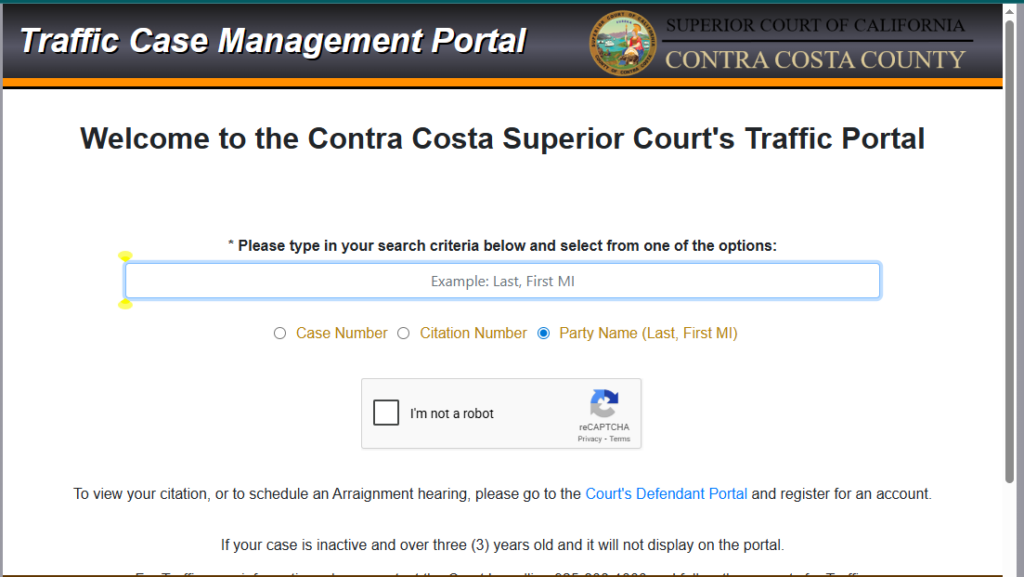
Drivers can search traffic tickets in Contra Costa County through the official Superior Court traffic system using citation details, name, or violation date. The search shows ticket status, fine amounts, court dates, and traffic school eligibility once the record appears in the system. Searching traffic tickets helps drivers stay updated on open cases and deadlines. Traffic citations move into the court database after law enforcement submits them to the superior court traffic division. Once entered, records become visible through the contra costa county traffic ticket lookup system. Early searches may show no results if the ticket is still in processing. A clear steps to process helps users avoid errors and locate accurate results through the California traffic violations court platform.
Official Traffic Ticket Search Website URL
Official URL: https://www.cc-courts.org/traffic
What Information You Need Before Starting
Having correct details improves citation lookup accuracy and saves time.
Prepare the following information:
- Citation number from the traffic ticket
- Driver’s full legal name
- Date of violation
- Court location listed on the ticket
Each item links the ticket to the correct court record.
Steps to Use the Traffic Ticket Search URL
Follow these steps carefully to complete a traffic case search.
Open the Official Website: Visit https://www.cc-courts.org/traffic/ using a secure browser.
Select Traffic Case Search: Choose the traffic or citation lookup option on the page.
Choose a Search Method: Pick one option based on available details:
- Citation number
- Name
- Violation date
Enter Required Details:Type information exactly as shown on the ticket. Check spelling and numbers.
Submit the Search: Click the search button and wait for results to load.
Review Results Carefully: Confirm the case matches the ticket details shown.
How Traffic Ticket Searches Work
Traffic tickets enter the system after officers file citation data with the court. Processing time may take several days. During this period, searches may return no results. Once entered, the court ticket search system displays the record. Name-based searches help if citation numbers are unavailable. Date-based searches narrow results when multiple records appear.
Traffic Citations in Contra Costa County
Traffic citations in Contra Costa County are official notices issued for driving-related violations and recorded by the court. Each citation contains key ticket details, deadlines, and violation codes that determine fines and case handling. Traffic citations in Contra Costa County serve as formal records of alleged driving violations. Law enforcement officers issue these notices during traffic stops or through mailed reports tied to camera-based enforcement. Once issued, the citation outlines the alleged offense and sets the timeline for court-related action. Every citation notice follows California traffic court standards, which keeps ticket formats and penalties consistent across counties. Drivers should review citation details closely, as each field connects to court records, fines, and response requirements. Clear awareness of how citations work helps avoid missed deadlines and added penalties.
What Information Is on a Traffic Citation
A traffic citation contains several data points that link the ticket to a court case. These details guide how the citation enters the system and how it appears in a lookup search. Each item supports accurate record matching during a traffic ticket lookup.
Common ticket details include:
- Citation number
- Driver’s name and license number
- Date, time, and location of the violation
- Vehicle information
- Court location and contact details
Violation Codes & What They Mean
Violation codes appear on every citation and reflect the specific traffic law involved. These codes link the ticket to California Vehicle Code sections. Courts use them to assign fines, points, or traffic school options. A single citation may list one or multiple codes based on the incident. Reviewing these codes helps drivers identify the nature of the violation and potential outcomes tied to the case.
Deadlines You Must Not Miss
Traffic citations include strict response deadlines. Missing a deadline may trigger higher fines or license-related actions. Deadlines usually appear near the bottom of the citation notice.
Key deadlines often involve:
- Fine payment due date
- Traffic school election window
- Hearing request submission date
How Citations Enter the Court
Citations enter the court system after law enforcement submits ticket data to the superior court traffic division. This step may take several days. Once processed, the citation appears in the court database and becomes searchable. Until entry is complete, lookup attempts may show no results. After entry, the case remains active until resolved through payment, hearing, or court order.
Traffic Court Fines, Fees & Penalties
Traffic court fines depend on the violation type, base fine, and state penalty assessments. The final traffic ticket penalties often exceed the original amount printed on the citation. Traffic court fines apply to most moving and non-moving violations handled by county courts. A ticket usually lists a base fine, yet that figure rarely reflects the final cost. California courts apply state and local assessments that increase the total amount due. These charges support court operations, emergency services, and state programs. For drivers, the result is a total cost that can feel unexpected. A clear breakdown of traffic court fines helps drivers plan payments and avoid missed deadlines.
How Traffic Fines Are Calculated
Traffic fines start with a base fine set by state law. Courts then apply multiple penalty assessments that increase the total amount due. Each assessment adds a fixed percentage or a flat charge based on the violation category. Once a citation enters the court system, the calculation process runs automatically using standardized formulas. As a result, a low base fine can rise quickly after all required charges apply. Totals vary by case details, prior history, and added penalties tied to the citation. Several factors influence how the final amount appears on a case record. Court systems apply mandatory fees that support statewide programs and local court operations. Late responses or missed deadlines may trigger extra charges. Some violations include additional costs related to correction verification or administrative handling. Each of these items contributes to the total balance shown during a traffic case review.
The total cost may include:
- Base fine linked to the violation code
- State penalty assessments
- County and court operation fees
- Conviction assessment charges
- Emergency medical services fee
- Court construction assessment
- Administrative processing costs
Fine Ranges by Violation Type
Fine amounts vary by violation severity, driving behavior, and prior history. Courts set a base fine for each violation, then apply state and county assessments that raise the final amount. This means two tickets with similar base fines may still result in different total costs. The table below shows typical ranges seen in traffic court cases to help drivers form realistic expectations. Actual totals may change based on added penalties, late fees, or correction requirements linked to the citation.
| Violation Type | Base Fine Range | Estimated Total Cost |
|---|---|---|
| Speeding (1–15 mph over) | $35 | $230–$260 |
| Red light violation | $100 | $480–$520 |
| Stop sign violation | $35 | $230–$260 |
| No proof of insurance | $100 | $900+ |
| Failure to appear | $300 | $900+ |
Court Fees & Surcharges
Courts add fees beyond the base fine. Each fee increases the total cost. The court lists these charges on the case record once processing finishes. These charges apply to most traffic cases.
Common additions include:
- State court construction assessment
- Emergency medical services fee
- Conviction assessment
- County administrative surcharge
What Happens If You Don’t Pay
Unpaid traffic court fines lead to added penalties and higher balances. Courts may issue a civil assessment, which can add a significant amount to the original total cost. A license hold may be placed on the driver record, which can stop license renewal or reinstatement until the balance clears. In some cases, the court may send the account to collections, creating long-term financial impact. Missed payments can block traffic school options and remove chances for reduced penalties. Repeated nonpayment may result in court notices that require a mandatory response. Setting up a payment plan or resolving the case early helps prevent these escalating consequences and keeps the case from growing more costly over time.
Traffic Court Appearance: Do You Need to Go to Court?
A traffic court appearance in Contra Costa County depends on the violation type and the notice printed on the citation. Some cases require a court hearing, while others allow resolution through payment or written response. A traffic court appearance contra costa cases follow set rules under the superior court traffic division. Every citation states whether a court visit is required. Some violations allow resolution without appearing, yet others demand attendance at a scheduled hearing. Knowing which path applies helps drivers avoid missed dates, extra fines, or license-related actions. This section explains when attendance is required, what alternatives exist, and what to expect during a traffic arraignment.
When a Court Appearance Is Required
A court appearance becomes mandatory in certain traffic cases that require judicial review. These cases usually involve higher-risk violations or unresolved court obligations. The citation or mailed court notice clearly states when attendance is required. Drivers should read this section carefully to avoid missing required dates. Failure to appear can change a simple citation into a more serious court issue. Court attendance allows the judge to review facts directly.
A court appearance is required when:
- The citation states “mandatory appearance”
- The violation involves reckless driving or excessive speed
- The case includes a failure to appear notice
- Proof of correction was not submitted on time
- The driver requests a court hearing to contest the ticket
When You May Resolve Without Appearing
Many traffic citations allow resolution without visiting the courthouse. These options apply to standard infractions that do not involve mandatory review. The citation notice lists eligible resolution methods and deadlines. Using these options helps drivers save time and avoid court visits. Payment or compliance still must occur within the set timeline. Missing deadlines can remove non-appearance options.
Common resolution methods include:
- Paying the fine by mail or online
- Submitting proof of correction
- Electing traffic school, if eligible
- Requesting a written declaration review
What Happens at a Traffic Court Hearing
A traffic court hearing follows a structured and orderly process. The judge begins by confirming the citation details. The officer may present facts related to the stop. The driver may speak, present documents, or explain the situation. Evidence such as records or photos may be reviewed. After review, the judge issues a decision.
Possible outcomes include:
- Fine confirmation or adjustment
- Case dismissal
- Traffic school approval
- New payment deadlines
What to Bring to Court
Preparation helps avoid delays and confusion during a court appearance. Bringing complete documentation supports smooth case review. Organized paperwork helps answer judge questions quickly. Missing documents may delay the hearing or affect outcomes. Arriving early allows time for check-in and review. Proper preparation supports a calmer court experience.
Items to bring include:
- Copy of the traffic citation
- Court notice or hearing notice
- Proof of correction or compliance
- Payment method, if required
- Any documents supporting the case
What to do After Receiving a Traffic Ticket?
After receiving traffic tickets Contra Costa drivers have several choices, including paying the citation, contesting it, or selecting traffic school if eligible. Each option leads to different outcomes related to cost, court involvement, and driving record impact. Traffic tickets contra costa cases come with clear response instructions and deadlines set by the court. Ignoring those instructions can increase fines or trigger license-related actions. Choosing the right option depends on the violation type, past driving history, and personal priorities. Some drivers prefer quick resolution, while others seek review by a judge. This section explains each option in detail so readers can choose with confidence.
Paying the Traffic Ticket
Paying a traffic ticket closes the case without further court review. This option fits drivers who accept responsibility for the citation. Payment confirms the violation and ends the matter once processed. Courts accept payment through online portals, mail, or in-person services. After payment posts, the case status changes to resolved. Points may still apply to the driving record depending on the violation.
Paying works best for those who:
- Want fast resolution
- Prefer no court hearing
- Meet payment deadlines
Contesting a Ticket
Contesting a ticket places the case before a judge for review. This option suits drivers who disagree with the citation or believe an error occurred. Contesting requires timely action and preparation. Drivers may present statements, documents, or witness accounts. The officer may also provide a report or appear. The judge reviews all information before issuing a decision.
Common reasons drivers contest tickets include:
- Incorrect citation details
- Disputed facts from the stop
- Unclear signage or equipment issues
Trial by Written Declaration
A trial by written declaration allows contesting a ticket without appearing in court. The driver submits a written explanation of events. The officer submits a written response. A judge reviews both submissions along with any evidence provided. This process follows strict deadlines and formatting rules. The decision arrives by mail after review.
This option works well for drivers who:
- Prefer written communication
- Have clear documentation
- Cannot attend court in person
Traffic School Eligibility and Payment Options
Traffic school in Contra Costa County provides drivers a way to prevent points from affecting their driving record. Eligibility depends on the type of violation and whether the driver has attended traffic school recently. While completing traffic school does not remove fines, it may help protect insurance rates. Courts set strict deadlines for enrollment and completion, and failing to finish the course removes the benefit. Eligible drivers typically must have a qualifying moving violation, no recent traffic school attendance, and complete the program within the court’s timeline.
For drivers facing financial difficulties, the court may allow extensions or payment plans. Requests are reviewed based on the balance owed and the status of the case. Approved plans allow smaller payments over time while keeping the case active and compliant. Options may include extended deadlines or monthly installment payments, though missing scheduled payments can cancel the plan and remove eligibility for benefits like traffic school.
Locations & Scheduling
Contra Costa County Traffic Court cases are heard at specific Superior Court locations throughout the county. Your citation or court notice tells you the correct courthouse, and court calendars list hearing dates that you must follow. Contra Costa County Traffic Court organizes traffic matters through multiple courthouse locations that serve specific regions of the county. Each site handles traffic citations, hearings, payments, and case processing based on the area where the violation occurred. Drivers should check their citation or reminder notice for the assigned court location, date, and session time. Arriving at the correct courthouse helps avoid added fines or missed hearing consequences. Court schedules and operating hours follow predictable patterns, but official holiday closures also apply. Understanding where to go and when supports on-time appearances and smoother case handling.
Traffic Court Locations in Contra Costa County
Contra Costa County Traffic Court operates at multiple Superior Court buildings. Your traffic citation or court notice will list one of these locations. Each courthouse works traffic cases for the communities and ZIP codes it serves. Attendance must match the assigned location unless the court explicitly approves a transfer. Each location accepts traffic fine payments, supports case inquiries, and processes hearings based on citation assignments. Clerks at these locations can clarify your case status if needed.
Main traffic court locations include:
- Contra Costa Superior Court – Walnut Creek Traffic Division
640 Ygnacio Valley Road, Walnut Creek, CA 94596
Handles traffic filings, hearings, and case payments. - Contra Costa Superior Court – Pittsburg Courthouse
1000 Center Drive, Pittsburg, CA 94565
Serves traffic cases from eastern and central areas of the county. - Contra Costa Superior Court – Richmond Courthouse
100 37th Street, Richmond, CA 94805
Handles traffic cases for western and northern Contra Costa cities.
Court Hours & Traffic Hearing Scheduling
Contra Costa County traffic courts are open on weekdays, typically 8:00 AM to 5:00 PM, with clerks available 8:00 AM to 4:00 PM for filings, payments, and inquiries. Traffic hearing calendars list morning and afternoon sessions at each location, such as Walnut Creek, Richmond, and Pittsburg, with trials usually starting around 8:30 AM and arraignments later in the morning or early afternoon. Drivers should check their citation or mailed notice for specific dates and arrive early to complete check-in procedures. If you need to reschedule a hearing, requests must be submitted before the original date. Courts review these based on availability, and approved changes result in a new notice. Missing a hearing without approval can lead to penalties or affect your case outcome.
Frequently Asked Questions
The information provided in this FAQ section is for general educational purposes only. It does not replace official court notices, court orders, or instructions issued by the Superior Court of California. Traffic court rules, timelines, and procedures may change based on case type and court policy. Readers should rely on their citation, mailed court notices, or official court systems for case-specific requirements and deadlines.
How long do traffic cases take in Contra Costa County?
Traffic cases in Contra Costa County move at different speeds depending on how the driver responds and what action the case requires. Simple cases that involve paying the fine or submitting proof of correction often resolve within a few weeks after the citation appears in the court system. Cases that involve hearings, written declarations, or rescheduling requests usually take longer. Court calendar availability, processing volume, and response timing all affect the timeline. A recently issued citation may not appear right away, which can delay early searches. Waiting too long to respond can extend the case and lead to added penalties. Drivers who check case status early, meet deadlines, and select a resolution option quickly usually see faster closure than those who delay action.
Can I handle my ticket online?
Many traffic tickets in Contra Costa County allow online handling through court-approved systems. Online options may include paying the citation, viewing case status, or selecting traffic school when eligible. Some cases also allow written declaration submissions without a courthouse visit. Eligibility depends on the violation type and the instructions listed on the citation or mailed notice. Tickets marked as mandatory appearance usually require an in-person court hearing. Online handling works best for standard infractions with no unresolved court issues. Drivers should confirm that their case qualifies before relying on online resolution. Using approved online options helps reduce time spent in court and keeps the case moving within required deadlines.
What if I lost my traffic citation?
Losing a traffic citation does not stop the court process. Once law enforcement submits the ticket, the court creates a case record tied to the driver’s information. Drivers can still locate their case using details such as name and date of violation. Court systems link citations to driver records, which allows case lookup without the physical ticket. Waiting too long to search for the case may lead to missed deadlines or added penalties. Checking case status early helps recover missing details and confirms response requirements. Court clerks can verify basic case information once the citation appears in the system. Acting early reduces the risk of penalties tied to lost paperwork.
How do I know my court date?
Court dates appear on the citation or on a mailed notice sent after the case enters the court system. Some citations list a date immediately, while others assign a date only after the driver requests a hearing. Online case systems may show hearing dates once scheduled. Drivers should review all mailed notices carefully, since court dates may change. Missing a scheduled hearing can lead to added fines or license holds. Checking case status regularly helps confirm the correct date and time. Early verification allows time to prepare documents or request rescheduling if allowed by court rules. Staying aware of the court date helps avoid serious case consequences.
Does traffic school remove points?
Traffic school does not remove the citation or fine, yet it may prevent points from affecting the driving record. Eligibility depends on the violation type and prior traffic school use within a set time period. Courts set deadlines for enrollment and completion, and missing those deadlines removes the benefit. Traffic school often helps drivers protect insurance rates linked to point increases. Not all violations qualify, and some cases allow traffic school only once within a specific timeframe. Drivers should confirm eligibility before selecting this option. Completing traffic school on time is required for the benefit to apply. Failure to complete it returns the case to standard penalty status.
What happens if I miss my hearing?
Missing a traffic court hearing can trigger serious consequences. Courts may add a civil assessment that increases the total balance owed. A license hold may follow, which can block renewal or reinstatement. The court may issue additional notices that require immediate response. Repeated missed hearings can limit future options and escalate the case. Ignoring the situation often leads to higher costs and fewer resolution paths. Contacting the court quickly after a missed hearing helps reduce added penalties. Acting early supports better outcomes and keeps the case from becoming more difficult to resolve.